

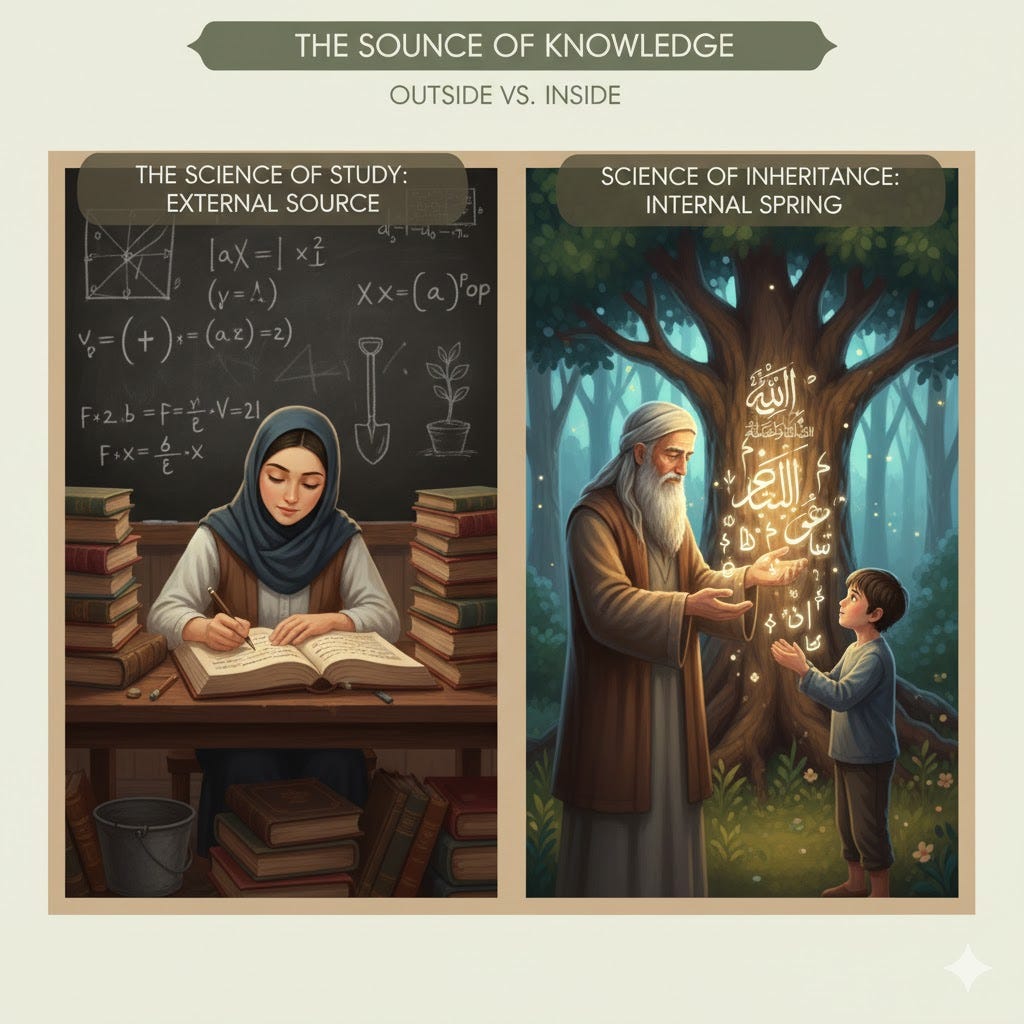
The Two Paths to Knowledge
This section introduces the article’s core concept: the “Science of Study” (earned knowledge) versus the “Science of Inheritance” (received knowledge).
Introduction: Why God Sent Prophets
God sent prophets to teach people. The Quran talks about two different types of knowledge:
Knowledge you can learn on your own - Things humans can figure out through experience, school, or thinking
Knowledge only God can teach - Things humans can never learn without God’s help
The Quran mentions both types. Some verses say: “They teach them the Book and Wisdom.” Other verses say: “They teach you what you could not have known.” That second phrase is important. It means: no matter where you go - school, university, anywhere - you could never learn this knowledge without God’s prophets teaching it to you.
Why We Need Special Teachers
This second type of knowledge requires a special kind of teacher - someone deeply connected to God. An ordinary teacher can teach you math, science, or history. But only someone with a strong connection to God can teach you the knowledge that comes directly from heaven. The Imam Ali (the Commander of the Faithful) said in Nahj al-Balagha: “I am the divine scholar of this nation.” He meant: I know both types of knowledge, and I can teach both.
Two Different Ways to Get Knowledge
The Science of Study This is knowledge you get through:
Going to school
Reading books
Studying and discussing
Writing and practicing
You work hard and earn this knowledge through effort.
The Science of Inheritance This is knowledge you get through:
Connection, not effort
Being close to the right people
Having a spiritual relationship with the Imams
A Simple Example
Think about money:
Earning money: You work hard, start a business, and become wealthy through your own effort
Inheriting money: Your father is wealthy, and when he passes away, you receive his wealth - not because you worked for it, but because you’re his child
The Science of Inheritance works the same way. You don’t earn it through study - you receive it through your connection to the Imams (the holy leaders descended from Prophet Muhammad).
How to Connect
The Quran says: “Be patient and connect.” Connect with:
The Quran
The Prophet’s family (Ahl al-Bayt)
The Imam of your time
When you make this connection, you’ll notice something amazing about how these two types of knowledge work differently.
The Garden and the Spring
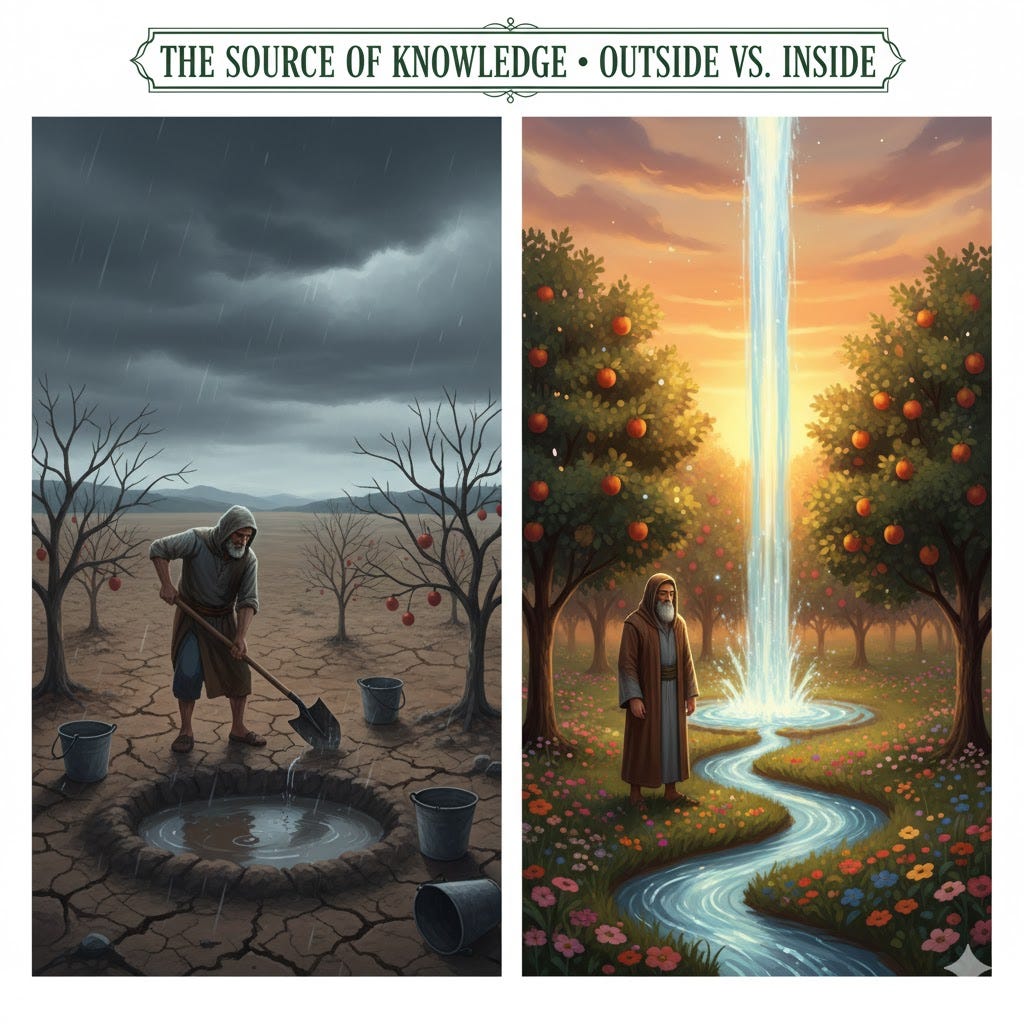
This section uses the central parable of the two farmers to explain the source of the knowledge—whether it comes from outside (study) or from within (inheritance).
The Big Difference: Where Does the Knowledge Come From?
The Garden Example Imagine two farmers with fruit gardens: Farmer #1 (Science of Study):
Digs a pond to collect rainwater
Depends on rain and outside water sources
If it doesn’t rain, his garden dies
Gets water from outside and brings it in
Farmer #2 (Science of Inheritance):
Has a natural spring inside his garden
Water bubbles up from deep underground
Never needs outside help
The water flows from inside out
The Science of Study is like Farmer #1 - you collect knowledge from outside sources. The Science of Inheritance is like Farmer #2 - knowledge flows from inside you, like a spring. This is why scholars say:
For the Science of Study, you need lessons and discussions
For the Science of Inheritance, you need love
The Power of Love and Purity
God says in the Quran: “God loves those who purify themselves.”
The Story of Quba Mosque When Prophet Muhammad migrated from Mecca to Medina, he built a mosque called Quba. God revealed this verse about it: “A mosque built on piety from the first day is more worthy. In it are men who love to purify themselves.” Notice two important things:
They work from love, not fear - They don’t obey God because they’re scared of hell. They do it because they love God and want to be pure like the Prophet’s family.
God loves them back - When they become pure, God loves them. And when God loves someone, knowledge flows into them like a spring.
Yes, going on pilgrimages like Arbaeen helps. Being careful about your actions helps. But ultimately, the Science of Inheritance flows from inside you when you have this love and purity.
What Imam Ali Really Wanted
Imam Ali didn’t just want people to study in schools. He wanted people to have this inner spring of knowledge. That’s why he took his student Kumail outside at night to teach him special things privately. If it was just ordinary knowledge, he could have taught him in the mosque during the day. Imam Ali wanted people who:
Work out of love for God
Want to be pure because the Prophet’s family is pure
Don’t just fear punishment, but genuinely love doing good
When you work from love instead of fear, it’s not a burden - it’s a joy.
The Ancient Promise & The Buried Treasure
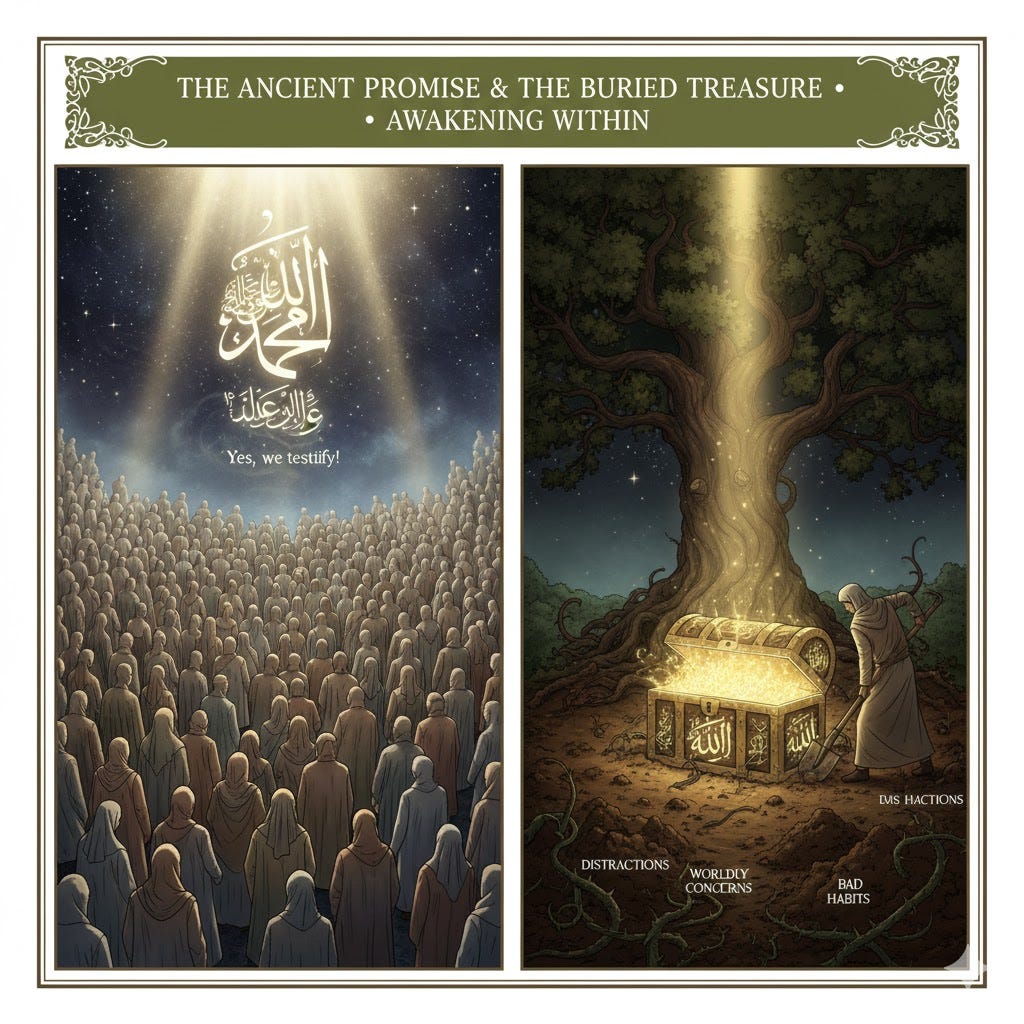
This section explores the origin of this “inner spring” of knowledge—the pre-historical covenant every soul made with God, which is now a “buried treasure” inside us.
Before We Were Born: The Ancient Promise
We’re Greater Than We Think We existed before this life, and we’ll exist after it. We’re greater than the sky, greater than the earth. We won’t just disappear.
The Day God Asked Us One of the most important verses in the Quran (Surah Al-A’raf) describes something that happened before any of us were born: “Your Lord brought forth all the children of Adam - everyone who would ever live - and asked them: ‘Am I not your Lord?’ They all said: ‘Yes, we testify!’” Before you were born in this world, God gathered every human soul that would ever exist. He showed Himself to all of us and asked: “Am I not your Lord?” And every single soul said: “Yes!”
Why Did God Do This? God explains why in the next verse: “So that on the Day of Judgment, no one can say: ‘I didn’t know about God’ or ‘My parents were non-believers, so I just followed them.’” God wanted to make sure that deep inside every person - no matter where they’re born or how they’re raised - there’s a knowledge of God. Even if someone grows up in a non-religious family, even if they live in a country where no one believes in God, they can’t say: “I had no way of knowing.” Because deep inside, everyone has this memory, this inner knowledge of God. No one is excused. Everyone has this inner voice of God inside them.
The Prophets Came to Wake Us Up
What Does “Revolution” Mean? The word “revolution” means to stir things up, to awaken something. Imam Ali said in Nahj al-Balagha: “The prophets came to stir up the treasures of people’s minds.” Think of it like this: God placed a treasure inside every person - the knowledge of God, the memory of that ancient promise. But over time, this treasure gets buried under:
Distractions
Bad habits
Worldly concerns
Following the crowd
The prophets came to:
Dig up that treasure
Remove the dirt covering it
Wake up that inner knowledge
Bring out the gem hidden inside
Everyone Must Join the Revolution
This isn’t just for one or two special people. Everyone needs to wake up together. For this to happen, you need:
A group of people
Working together
Following the right leaders
The prophets weren’t just teachers standing at a blackboard. They were revolutionary leaders, waking people up and stirring up the truth inside them.
The Imams as the “Field of Revolution”
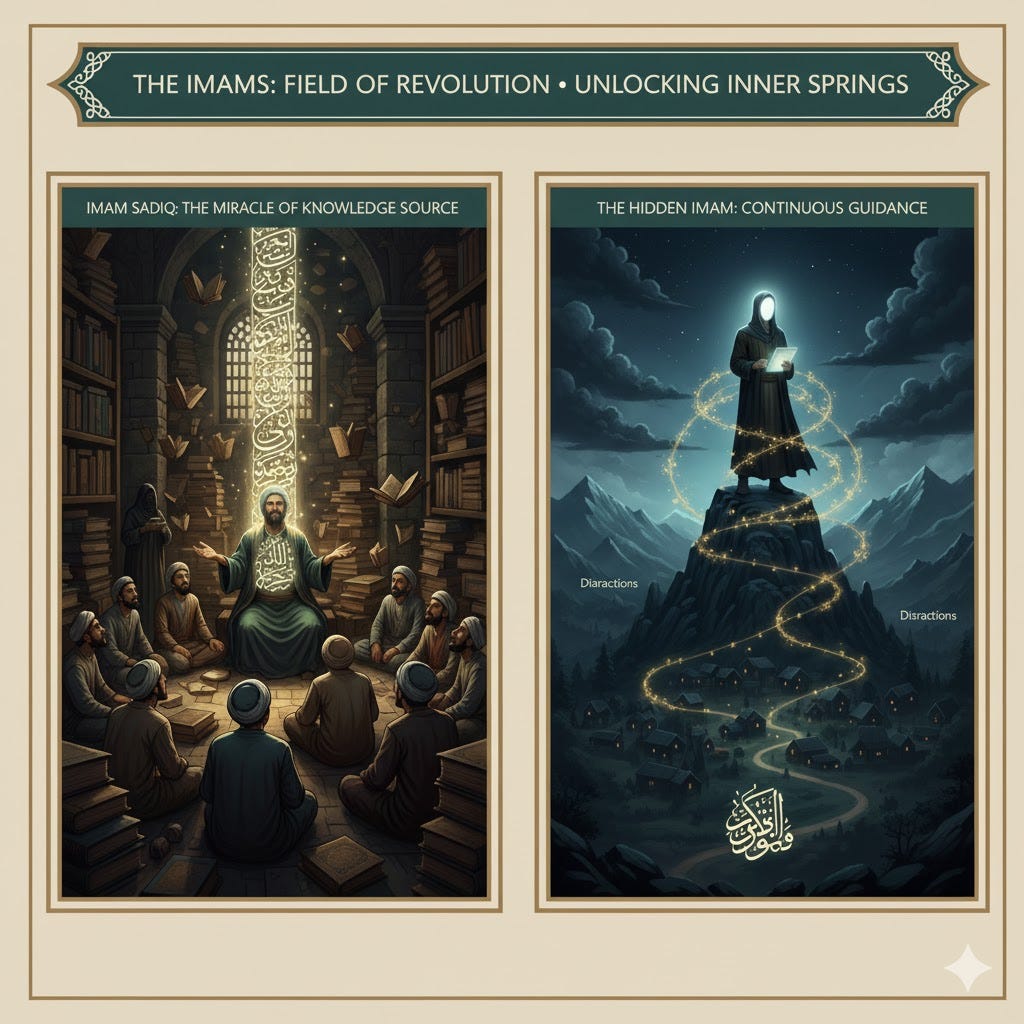
This section focuses on the specific role of the Prophet’s family (Ahl al-Bayt) as the guides and living examples who unlock this “buried treasure.”
Imam Ali said: “We, the Prophet’s family, are the field of revolution.”
The Amazing Example of Imam Sadiq
Living Under Oppression After Imam Husayn (the Prophet’s grandson) was martyred, the Abbasid rulers controlled everything. They pretended to be friendly to the Prophet’s family, but they actually poisoned and imprisoned them. Imam Sadiq and his father Imam Baqir were not allowed to teach freely. Only a few students could secretly come to them.
The Miracle of Knowledge But here’s what’s amazing: Despite all these restrictions, Imam Sadiq produced:
The Four Books - the main collections of Shia teachings
Material for the 100 volumes of Bihar al-Anwar - an enormous encyclopedia
When you read these books, almost every page says: “Imam Sadiq said...” “Imam Sadiq said...” “Imam Sadiq said...” Think about it: If you tried to write just one book, it would take your whole life. How did Imam Sadiq produce so much knowledge while being watched and restricted by the government? This is the Science of Inheritance. Knowledge flowed from inside him like a spring. Imam Ali said: “We are the pioneers of knowledge. We are the field of revolution.” Connection with them has this same effect.
The Spring Inside Everyone
God did this so no one could make excuses. Whether someone grows up in a Muslim family or not, whether they live in a religious country or not - everyone has this spring of knowledge inside them. Finding this spring, digging it up, and letting it flow - this is Imam Ali’s work.
A True Story: The Scholar Who Remembered
The great scholar Allama Tabataba’i once asked his teachers in Najaf (a holy city in Iraq): “Do you remember that scene from Surah Al-A’raf? When God gathered all souls and asked, ‘Am I not your Lord?’” One of them answered: “I remember it to some extent.” This scholar had reached such a high spiritual level that he could actually remember that moment before birth when God made the covenant with all humanity.
What About Now? The Hidden Imam
Some people think: “The 12th Imam is in hiding, so he’s not doing anything.” This is wrong! Just like Imam Sadiq and Imam Baqir, the Imam of our time (Imam Mahdi) is still working. He may not be teaching publicly like they did, but he absolutely has the Science of Inheritance and is using it. Don’t think that because he’s hidden, he’s inactive. He is constantly working with the Science of Inheritance. God has:
Knowledge of the unseen (what’s hidden)
Knowledge of the seen (what’s visible)
The Imam has access to both.
Graduating to True Understanding
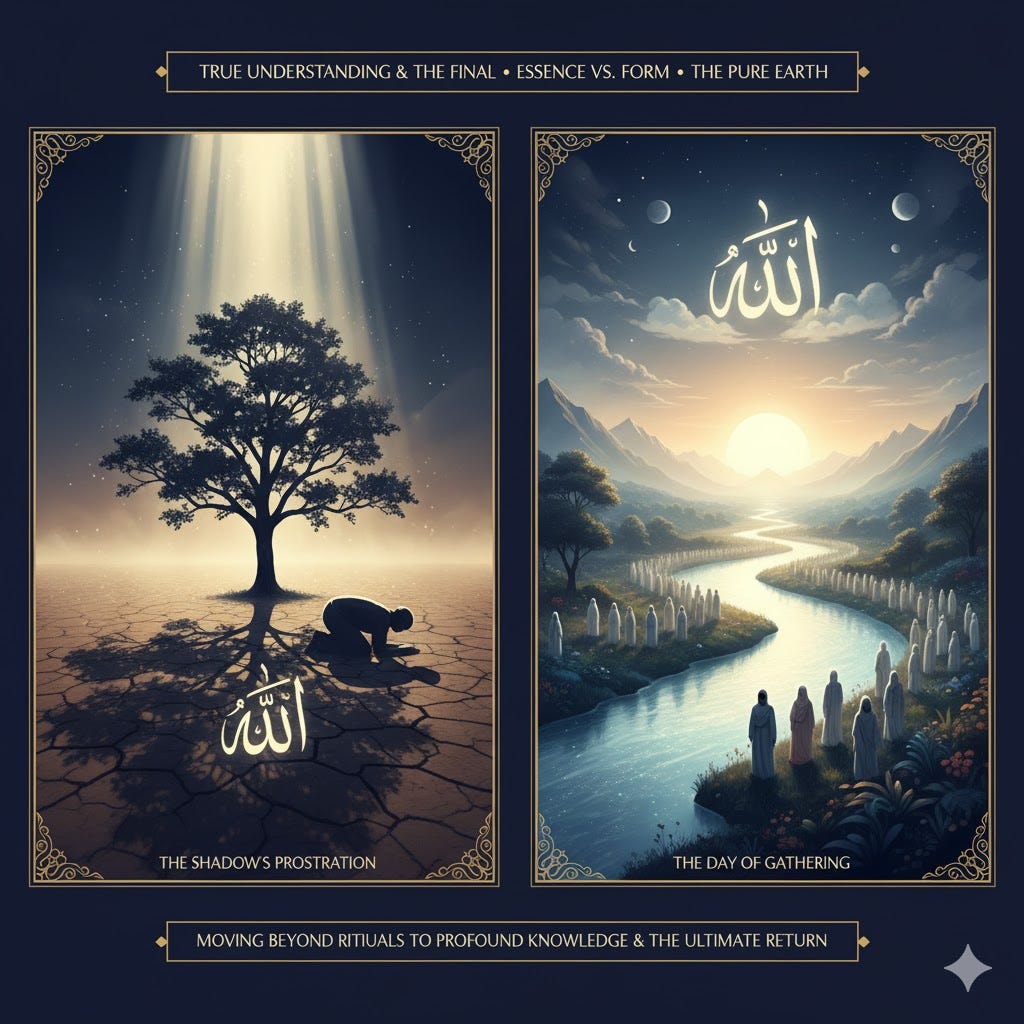
This final section explains the goal of this knowledge: to move beyond basic rituals to a profound, essential understanding of God, and it recaps the complete human timeline.
Different Goals
Many people practice religion to:
Get rewards
Go to heaven
Avoid hell
These are good goals, and God will give these to many people. But there’s another level: If you want to be the kind of person the prophets were training - someone with that inner spring of knowledge flowing - then you become connected to that ancient promise, to that pre-historical moment when God asked: “Am I not your Lord?”
Beyond Rituals to Real Knowledge
Many religious practices are good:
Crying in remembrance of the martyrs
Making offerings
Making vows
All of these have rewards and will help you in the afterlife. But using the knowledge of the Imams is something else - something deeper.
The Story of Hisham
A student named Hisham came to visit the Imam. After greetings, the Imam asked: “Can you describe God?” Hisham said: “Yes.” “Tell me, how do you describe God?” Hisham said: “He is All-Hearing,” and listed some attributes. The Imam said: “But those are attributes that creatures also have. Humans can hear too. That’s not a proper description of God.” Hisham was confused: “Then what should I say?” The Imam explained: “When we say God is ‘All-Hearing,’ we don’t mean He has ears like we do. We mean His very essence is knowledge. His knowledge IS His essence. He doesn’t hear through a body part - hearing is part of His fundamental nature.” The Imam taught him the proper way to understand God’s attributes. Hisham later said: “I left his presence and taught people about monotheism.” He didn’t just walk out the door - he graduated from the Imam’s school. He went from being a student to being a teacher, able to teach others the true understanding of God.
Both Types of Knowledge Matter
The Imam said: “I am a divine scholar. I have both the Science of Study and the Science of Inheritance.”
A Beautiful Parable: The Shadow
Imam Ali gave this beautiful example: The sun shines on a tree. The tree casts a shadow on the ground. Now think about this shadow:
The sun created it
But the shadow turns its back to the sun
The shadow faces toward God
The shadow is prostrating (bowing) to God
Even though the sun made the shadow, the shadow doesn’t worship the sun - it worships God! The Quran says (in Surah Ar-Ra’d and An-Nahl): “Everything prostrates to God.” There is nothing in the entire universe that doesn’t humble itself and bow before God.
The Scene Inside Everyone
This scene - this knowledge of God, this ancient promise - is inside everyone. The prophets came to cause a revolution, to wake this up in people. Since everyone needs to wake up together, they need a field for this revolution. Imam Ali said in Nahj al-Balagha: “We are the field of revolution.” The Prophet’s family - the Imams - are the leaders who can wake up that inner knowledge in everyone.
After This Life: The Day of Gathering
Everything Will Change The Quran says: “The first and the last of humanity will be gathered for the appointment of a known day.” “The Day when the earth will be changed to another earth, and the heavens as well.” God will:
Replace this earth with a different earth
Replace this sky with a different sky
Gather everyone - from the first human to the last
A Pure Earth Imam Sajjad explained: “God will replace this earth with a land on which no sins have been committed.” Imagine that - a completely pure earth where no one has ever done anything wrong.
The Complete Timeline
Before birth: God gathered all souls and made the covenant
This life: We’re living in the world, with that inner knowledge buried inside us
After death: We’ll be gathered again on a new, pure earth
We who live now are in the middle, living in the cradle of monotheism (belief in one God), with that ancient promise still inside us.
Final Prayer
We hope that:
This Islamic system
This community
All the scholars and elders
Will be included in the special prayers of Imam Mahdi (may God hasten his return). “And all praise belongs to God, Lord of all the worlds.”
References
[1] Surah Al-Baqarah, verse 129
[2] Surah Al-Baqarah, verse 151
[3] Surah An-Nisa, verse 113
[4] Surah Al-Alaq, verse 5
[5] Surah Luqman, verse 12
[6] Vocabulary of Alfaz al-Qur’an, p. 337; See: Nahj al-Balagha, Khutbah 108
[7] Nahj al-Balagha, Wisdom 5
[8] Surah Al-Imran, verse 200
[9] Surah Al-Baqarah, verse 222
[10] Surah At-Tawbah, verse 108
[11] Surah Al-A’raf, verse 172
[12] Surah Al-A’raf, verse 173
[13] Surah Al-Hujurat, verse 6
[14] Nahj al-Balagha, Sermon 1
[15] Nahj al-Balagha, Sermon 105
[16] Al-Mahasen and Al-Masawi (Beyhaqi), p. 186
[17] Surah Al-Waqi’ah, verses 49-50
[18] Surah Ibrahim, verse 48
[19] Tafsir al-Qummi, vol. 2, p. 252
[20] Al-Tawhid (by Al-Saduq), p. 146
[21] Surah Ar-Ra’d, verse 15
[22] Surah An-Nahl, verse 48