

The Sapling of Wilayah in the Family Structure: Cultivating Devotion Through Parental Respect
Video:
Audio:
Original Audio from Sheikh Ali Reza Panahian’s Website
Understanding the Profound Connection Between Honouring Parents and Spiritual Leadership
The concept of wilayah (spiritual guardianship) and devotion to the Ahl al-Bayt (peace be upon them) stands as a cornerstone of faith for believing families. However, the path to becoming a true follower of Imam al-Mahdi (may Allah hasten his reappearance) does not begin on distant battlefields or within the walls of grand mosques. It begins within the intimate confines of our own homes.
Every religious household recognises that without their children’s love and devotion to the Imam of the Time, all other achievements—academic success, social status, or wealth—lose their value. But this devotion is not merely a feeling; it is a discipline that requires practical training, specifically through the relationship with one’s parents.
The Foundation of Wilayah-Centered Upbringing
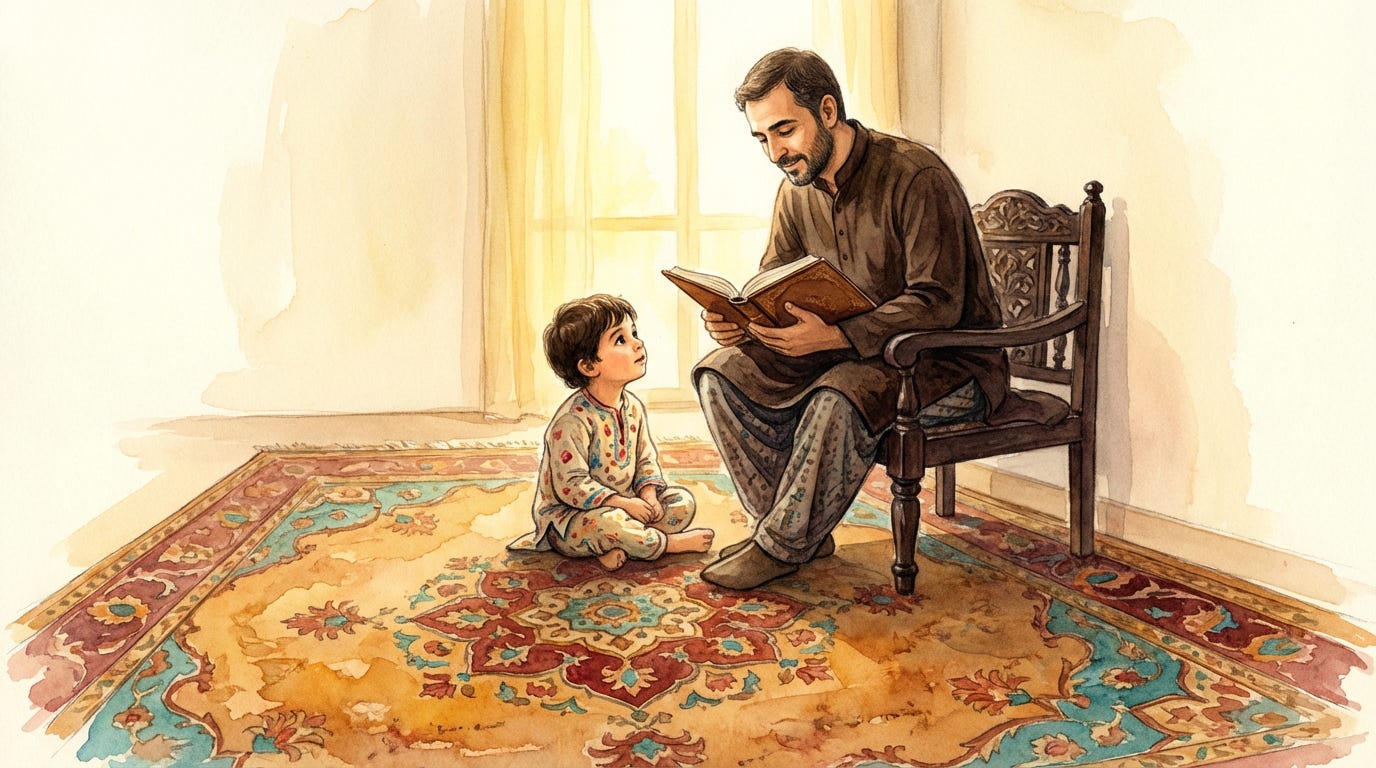
Parents naturally place the love of Ali ibn Abi Talib (peace be upon him) at the forefront of their educational goals. As the Prophet Muhammad (peace be upon him and his family) stated, love for Ali will be the “title of the believer’s record” of deeds. At the moment of death, the first sight will be of Ali.
However, a critical question arises: How is this love cultivated?
“Which school should we enroll our children in to make them wilayah-centered? Which lessons should they study? Which books should they read? Neither books, nor lessons, nor schools will accomplish this task. The relationships defined within the home—between parent and child—these teach our children the meaning of wilayah. There is no other way.” — Sheikh Panahian
The Quran repeatedly mentions the prohibition of polytheism immediately followed by the command ‘wa bil-walidayni ihsana’ (and be good to parents). This juxtaposition appears four times in different expressions, highlighting that respecting parents is not merely a recommendation, but a strategic pillar in building a soul capable of divine obedience.
The Gravity of Disrespect
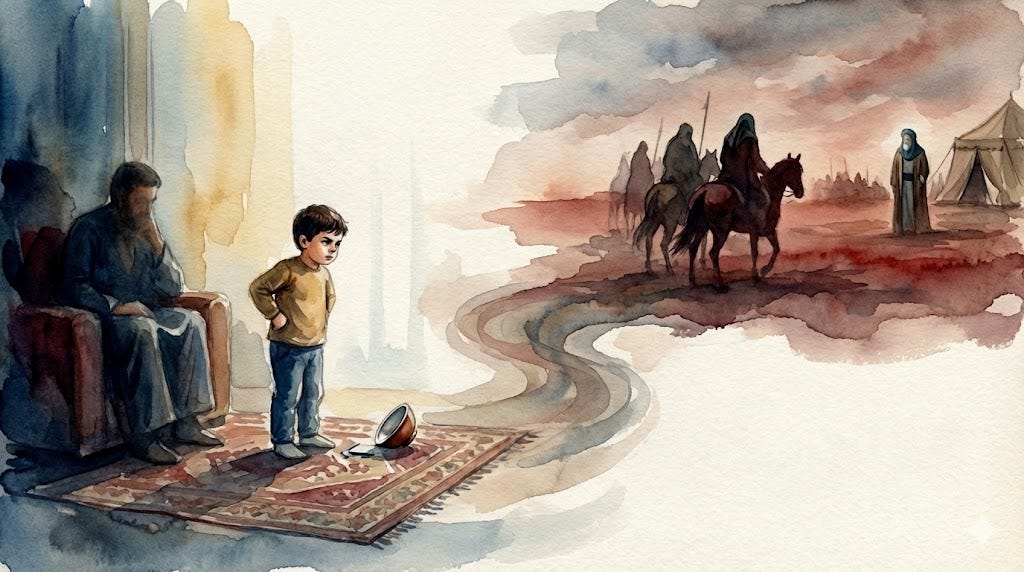
While believers may occasionally fall into sin or error, showing disrespect to the Ahl al-Bayt constitutes a transgression of an entirely different magnitude. The history of Karbala serves as a stark warning: many who participated in that tragedy did not initially intend to kill Imam Hussein (peace be upon him). They descended into darkness gradually.
What begins as minor negligence or disrespect in the home can escalate. If a child learns to defy the authority of the parents Allah has assigned to them, they risk developing a spirit of defiance that may eventually turn against Divine authority itself.
The Complex Nature of Obedience: Musa and Khidr

Many claim, “I would easily obey Imam al-Mahdi if he appeared because his character is perfect.” However, this perspective is flawed. The Quranic story of Prophet Musa (Moses) and Khidr reveals that obedience to divine authority is incredibly complex.
Despite being a prophet of high station, Musa struggled to remain silent when Khidr performed seemingly incomprehensible acts—damaging a ship, building a wall for inhospitable people, and most severely, taking a life.
“Indeed, you will never be able to have patience with me.” — Khidr to Prophet Musa
Sheikh Panahian notes the irony: “You say so easily that when Imam al-Mahdi comes, I will obey him. But Imam al-Mahdi is greater than Khidr, and you are less than Musa. How will you maintain patience in the complexities of wilayah?”
The Test at the House of Ali

This difficulty was historically proven when enemies came to burn the house of Ali ibn Abi Talib. The companions present faced a severe test of obedience. Zubayr drew his sword without permission to defend the house—a seemingly noble act—yet was rebuked because he acted without the Imam’s command. Only Miqdad passed the test, keeping his eyes fixed on Ali, hand on his sword hilt, ready to act only upon his master’s signal.
Wilayah-madari (devotion to leadership) requires training in unconditional obedience, even when we do not understand the wisdom behind a command or silence. Where better to practice this than with parents who may be difficult, or whose requests seem unreasonable?
Divine Wisdom in Parental Selection

One might ask, “Why do I have difficult parents?”
Allah knows precisely what type of parents each person needs. He understands our spiritual needs and what aspects of our character require development. Just as different athletes need different trainers—a wrestler’s coach differs from a volleyball player’s—Allah has matched each person with parents whose particular characteristics will best facilitate their spiritual growth.
If your mother speaks harshly, perhaps you need to develop patience against harsh words.
If your father is strict, maybe you need to learn submission to authority.
If your parents are critical, perhaps you need to develop resistance to criticism.
Allah’s selection is never random; it is precisely calibrated to your spiritual needs.
Practical Guidelines from Imam al-Sadiq
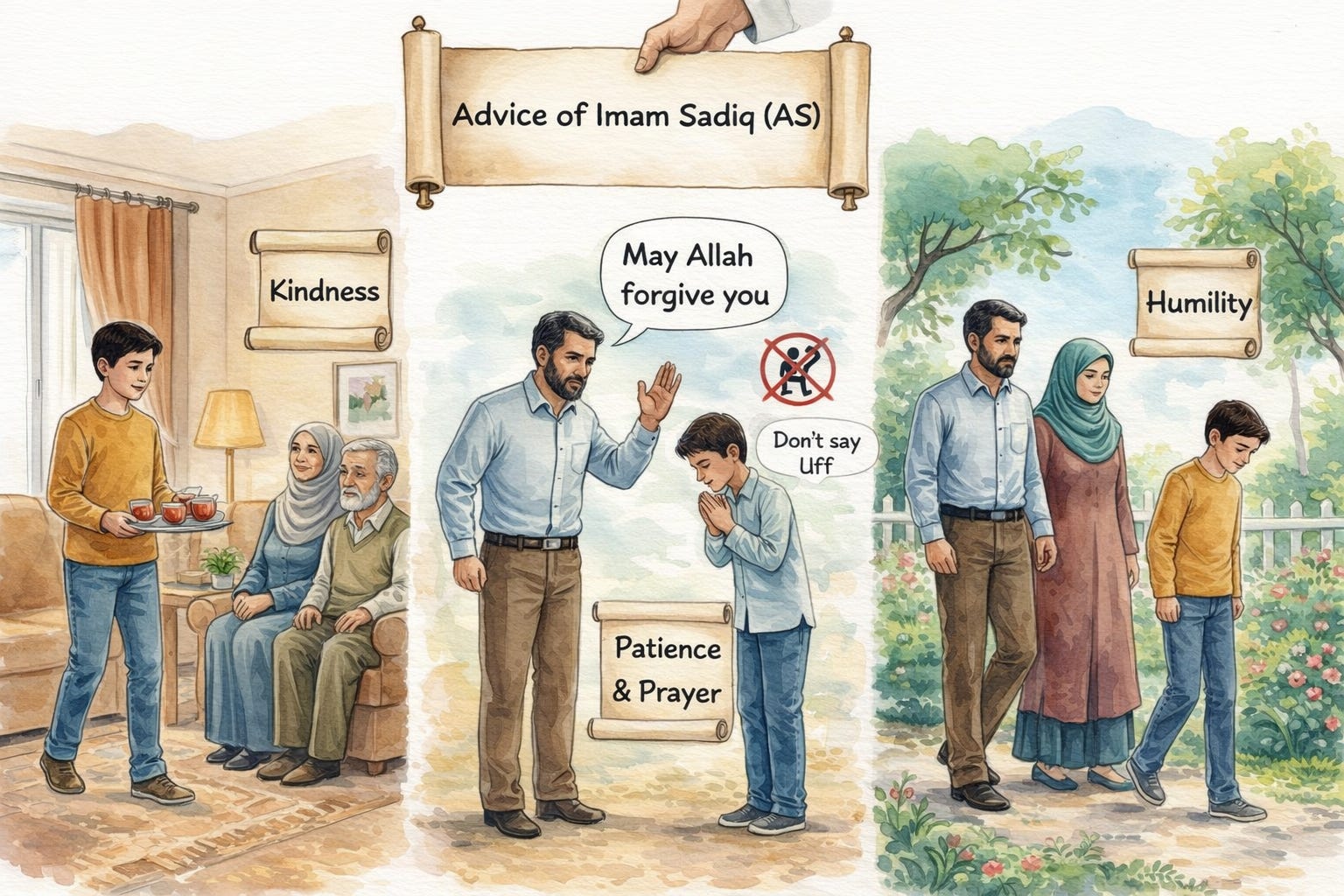
When asked about the meaning of ‘ihsan’ (excellence) toward parents mentioned in the Quran, Imam Jafar al-Sadiq (peace be upon him) provided specific, challenging guidance:
Proactive Service: Never force them to ask for what they need; anticipate their needs even if they are self-sufficient.
Pleasant Company: Keep them company pleasantly; make them enjoy your presence.
The Ban on “Uff”: Never say “uff” (a sigh of frustration), even if they cause you distress.
Response to Aggression: If they strike you, the only permissible response is to say, “May Allah forgive you.”
Physical Humility: Do not stare at them except with mercy and tenderness. Never raise your voice above theirs. Do not walk ahead of them or raise your hand in their presence.
Stories of Steadfastness

History and contemporary examples show us how this respect shapes the soul.
The Fragrance of Uwais: Uwais al-Qarni, a devoted lover of the Prophet, had a mother who did not believe. When she finally permitted him to visit Medina, she set a condition: he must return by sunset. Uwais traveled all the way to Medina only to find the Prophet was absent. Faithful to his mother’s command, he returned home without seeing his beloved Messenger. Later, the Prophet said he smelled the fragrance of Uwais in Medina—his obedience to his mother raised his spiritual status higher than if he had stayed.
The Student’s Discipline: In a more recent example, a young man whose father was abusive adopted a strict strategy. Whenever his father became angry, the son would immediately leave the house. He explained, “I fear I might say something disrespectful if he pushes me too far, so I remove myself to protect my respect for him.” Another student maintained perfect grades solely to prevent his father from criticizing his religious activities, using academic excellence as a shield to protect his spiritual duties.
The Tragedy of Broken Families
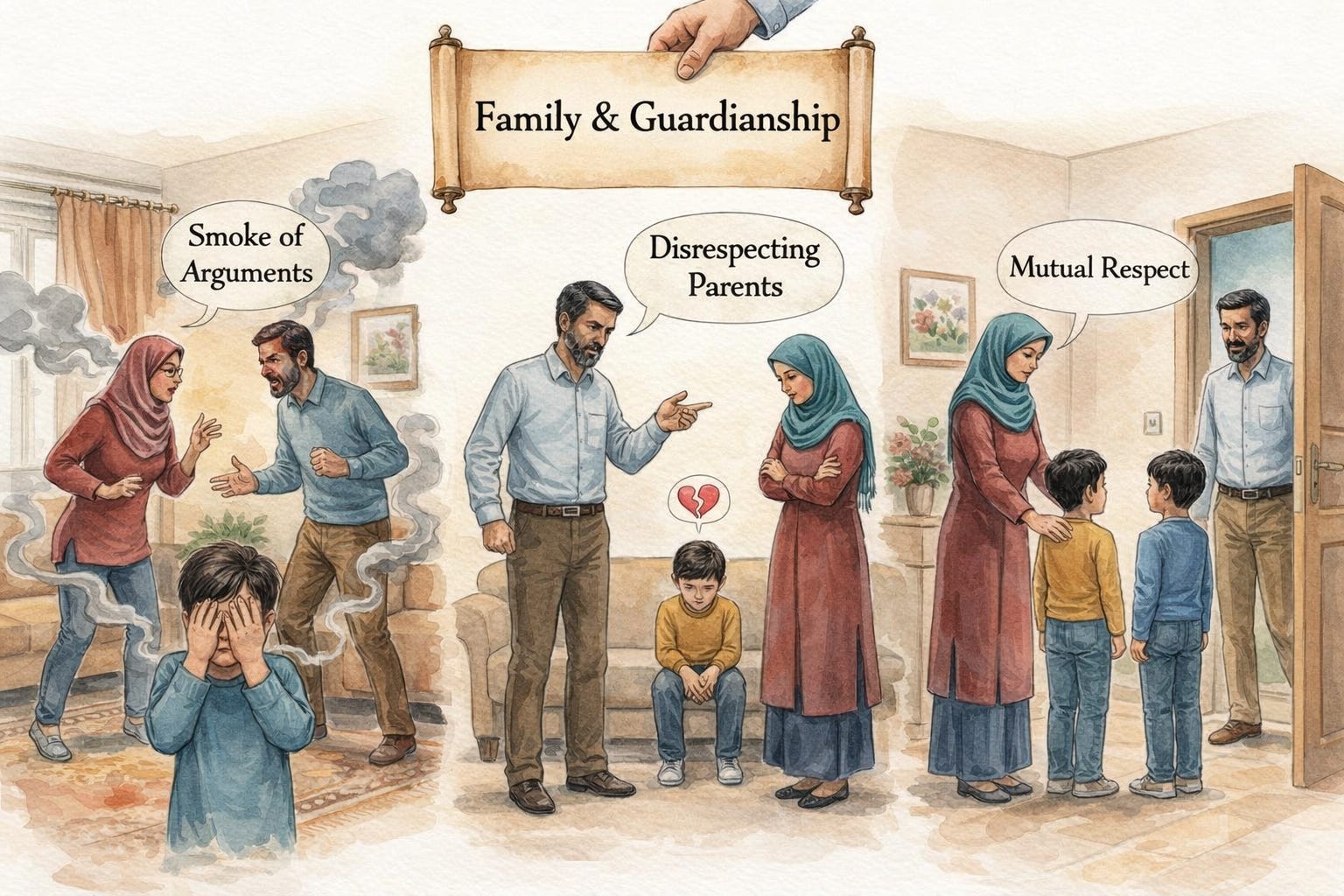
While children must honour parents, parents bear a heavy responsibility to honour each other. The foundation of wilayah is destroyed in homes where parents fight in front of their children.
“The one who maintains the respect of parents is the other parent. When a father disrespects the mother before the children, or vice versa, the children lose respect for both. When they fight, the smoke gets in the children’s eyes.” — Sheikh Panahian
Mothers should act as “class monitors,” preparing the children to receive the father with respect. Fathers must strictly forbid any disrespect toward the mother. This mutual reinforcement creates an atmosphere where children naturally learn to respect authority.
Conclusion: The Lesson of Karbala

The ultimate goal of this training is to produce a heart capable of supporting the Imam of the Time. This requires a unique blend of strength and tenderness.
The narrative concludes with the heart-wrenching account of Qasim ibn Hassan in Karbala. When this orphaned nephew sought permission to fight, Imam Hussein’s grief was so intense that he collapsed. The Imam initially refused, fearing Qasim might feel discriminated against as an orphan. Only after repeated pleas did he embrace Qasim and grant permission.
This scene demonstrates that the warriors of Karbala—and the future warriors of Imam al-Mahdi—must possess not just battlefield courage, but profound familial love and tenderness.
The path to becoming a supporter of divine leadership begins with honouring those whom Allah has placed as authorities in our lives. By lowering our wing of humility to our parents, we raise our status in the eyes of God and prepare our hearts for the return of the Savior.
Original: Voice | The Guardianship Seedling in the Family Institution | panahian.ir